Weak or manual product recommendations
Give back the hours you spend hand-curating product widgets
Ecommerce brands automate recommendations instead of building them by hand on Maestra Platform, a marketing personalization platform that pairs every account with a dedicated forward-deployed marketer.
Brands running on Maestra






The problem
Customers stay in one category and never see the rest of what you sell
Without automated, behavior-based cross-sell, shoppers who love one product line rarely discover adjacent ones. Campaigns end up treating every customer the same, missing the natural next purchase that's sitting right in your own catalog.
What we hear from brands
a natural body-care brand has limited ability to cross-sell soap buyers into skincare, with campaigns that treat all customers the same
a designer home-decor brand lacks automated product cross-sell flows and custom data points like product-view events
an online seafood purveyor cites limited cross-sell visibility and the need for better flow optimization and A/B testing
The new way
When browsing isn't enough, ask the customer directly
Product-picking quizzes cure decision fatigue by asking a few short questions and surfacing matching products immediately, while capturing preferences that sharpen targeting across every channel. Pair that with value-packed bundles built from products that actually go together, and discovery stops depending on the customer getting lucky.
Outcomes brands report
Customer proof
Selkirk Sport got 15 hours a week back from manual product curation

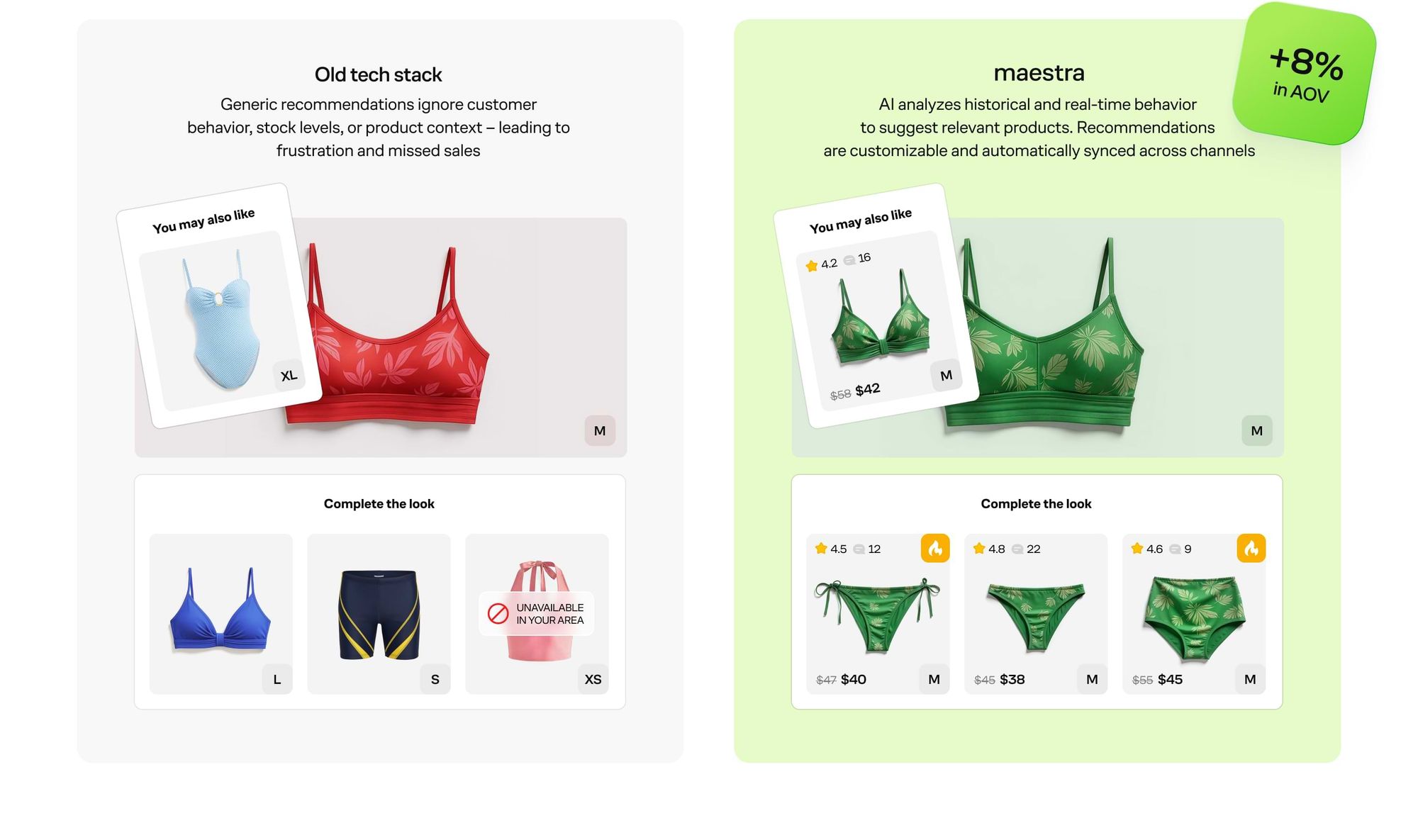
Hand-picked recommendations with no testing capability were limiting how much Selkirk Sport could scale or optimize its merchandising. Maestra's AI-powered recommendations took over the manual picking, running always-in-stock, relevant suggestions with flexible A/B testing built in.
15
hours saved weekly on manual product curation

“Before Maestra, I had to manually select products for each recommendation placement, individually, for every single product. There was no room for nuance, and a lot of our catalog never got proper recommendations. I knew better merchandising could add 10-20% more revenue, but the effort required made it impossible to scale.”
How it works
The part where you do almost nothing
Say yes to the plan
Your forward-deployed marketer builds the migration plan and walks you through it. Approving it is most of your job.
Everything transfers in the background
Data, segments, flows, and campaign templates move over while your current platforms keep working, so customers never notice a gap.
Deliverability gets warmed up for you
Domain warm-up and sending reputation are handled as part of the switch, not left for you to figure out after launch.
The platform
Ten products, one customer profile
Maestra's ten modules all pull from the same commerce-specific data model, so recommendations, journeys, and loyalty logic all react to the same real-time customer profile. Under the hood, the platform runs at 2M RPM with under 300ms processing.
Including
Your forward-deployed marketer
The math behind better support: fewer accounts per person
Most vendors stretch one account manager across 60 or more accounts. Maestra caps forward-deployed marketers at under 15, which is the reason a 5-minute response time and four monthly meetings are even possible.
Fewer than 15 accounts per marketer, versus 60+
5-minute response time versus 72 hours
4 meetings a month versus 1
Replace your stack
Segmentation, messaging, and loyalty, finally in sync
Tools like Segment can handle segmentation, but activating that segment across email, SMS, and loyalty still requires other systems. Maestra keeps segmentation and activation in the same platform, so a segment change shows up everywhere instantly.
Get a straight answer on fit
Talk to an expert about whether Maestra actually solves what your current stack cannot.